Statehouse Leaders Race to Complete Business |
|
|---|
|
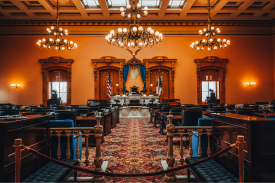 |
Ohio legislative leaders are preparing for a busy final stretch of activity before lawmakers leave Columbus later this week for an extended break. House Speaker Matt Huffman has identified several major items he would like to complete before the break, including the state capital budget, a proposed voter ID constitutional amendment, data center policy, and Medicaid fraud legislation. The Senate has already moved on two of those priorities, approving its version of the capital budget and the voter ID amendment last week. Senate President Rob McColley has said his goal is for the Senate to complete its pre-recess work by Wednesday, although the chamber has an additional if-needed session scheduled for June 17. McColley also left open the possibility of additional committee activity or sessions if needed to move priority legislation before the break. While relevant committees have been holding marathon hearings on data centers and Medicaid fraud, legislative details are still under development. Based on testimony thus far, data center proposals could include: - Requiring data centers to cover the cost of new electric infrastructure needed to serve their projects;
- Improving utility load forecasting to separate real projects from speculative proposals;
- Requiring stronger financial commitments from developers before utilities build new infrastructure;
- Encouraging or requiring new power generation, behind-the-meter generation, or demand-response commitments;
- Reforming Ohio’s data center tax incentives, including possible limits on duration, percentage of exemption, and eligibility;
- Requiring more transparency around water use and local infrastructure impacts;
- Restricting NDAs and increasing disclosure around project size, power demand, backup generation, and environmental impacts;
- Strengthening local notice and community engagement before major projects move forward.
On Medicaid, lawmakers are considering a package of reforms with a particular focus on higher-risk provider categories such as home health, home- and community-based services, and behavioral health. Proposals under discussion include: - Stronger provider enrollment screening and more frequent provider revalidation;
- In-person inspections for certain providers before they can enroll in Medicaid;
- Greater scrutiny of providers using shared addresses or other suspicious business arrangements;
- Expanded electronic visit verification requirements for in-home services;
- Temporary payment suspensions when suspicious billing patterns are identified;
- Stronger criminal penalties and restitution requirements for Medicaid fraud;
- Whistleblower protections and potential rewards for fraud reporting;
- More transparency and reporting from Medicaid managed care organizations;
- Enhanced authority and reporting tools for the Auditor of State, Attorney General, and Medicaid fraud investigators.
The compressed timeline matters. Once the legislature breaks, it is not expected to reconvene until after the November elections. For businesses, associations, local governments, and other stakeholders, this is the type of week where quick engagement can matter. Amendments can move fast, negotiations can happen behind the scenes, and bills that appear stalled can suddenly become part of a larger end-of-session package. |
|
|---|
|
 This is an aggressive agenda for a very short legislative window. House and Senate leaders will need to move quickly to align priorities, finalize language, manage committee activity, and secure enough votes to move major bills before the end of the week. This is an aggressive agenda for a very short legislative window. House and Senate leaders will need to move quickly to align priorities, finalize language, manage committee activity, and secure enough votes to move major bills before the end of the week. |
|
|---|
|
Ohio Voters Will Decide Voter ID Amendment in November |
|
|---|
|
Ohio voters will see at least one statewide issue on the November ballot: a constitutional amendment to place voter photo identification requirements into the Ohio Constitution. The proposal would generally require voters casting ballots in person, either on Election Day or during early in-person voting, to present valid government-issued photo identification. Current Ohio law already requires photo ID for in-person voting, but placing the requirement in the Constitution would make it more difficult for future legislatures to change. Absentee voters would still be able to provide identifying information, such as the last four digits of a Social Security number, when voting by mail. The proposed amendment to abolish property taxes will not make the ballot this year. Backers of the issue announced late last week that they will not file signatures for the 2026 ballot but will continue gathering signatures in an effort to qualify for the 2027 ballot. A proposed data center ban also faces a difficult path. Supporters have not shown significant organization to date and appear unlikely to file by the July 1 deadline. To qualify for the November ballot, citizen-led constitutional amendments must submit more than 413,000 valid signatures, meaning campaigns typically need to collect far more than the minimum to account for invalid signatures. |
|
|---|
|
 The Voter ID amendment is headed to voters because it is being placed on the ballot by the legislature, rather than through a citizen signature drive. By contrast, the property tax repeal and data center ban efforts have faced the much more difficult task of building statewide petition operations. The Voter ID amendment is headed to voters because it is being placed on the ballot by the legislature, rather than through a citizen signature drive. By contrast, the property tax repeal and data center ban efforts have faced the much more difficult task of building statewide petition operations. |
|
|---|
|
| Senate Passes Capital Budget; House Expected to Follow |
|
|---|
|
 |
The Ohio Senate unanimously approved a $3.7 billion capital budget last week, and the House is expected to pass an identical version later this week SB 450 cleared the Senate Finance Committee without amendments or additional testimony before passing the full Senate. The House companion, HB 959, has had an initial hearing, and House leaders are expected to move the same package tomorrow. The Office of Budget and Management has described the plan as balanced and fiscally responsible. The bill reflects months of bipartisan work with the DeWine Administration. Most of the package, $3.43 billion, is backed by General Revenue Fund bonds, with another $263.3 million coming from cash and federal sources. Education again receives a significant share, including $753.2 million for the Ohio Facilities Construction Commission for K-12 projects and $560.4 million for higher education. Other major allocations include: - $720 million for the Ohio Public Works Commission;
- $400.4 million for the Department of Behavioral Health, including $385 million to renovate six psychiatric hospitals;
- $265.3 million for park lodges, cabins and campgrounds, plus a 12,000-acre purchase expanding six state forests and two wildlife areas;
- $246.2 million for correctional facilities;
- $208.3 million for community projects, with Cuyahoga, Franklin and Hamilton counties each receiving roughly $22 million.
|
|
|---|
|
Ohio’s Top 2026 Races Are Competitive |
|
|---|
|
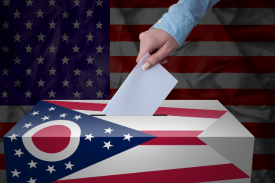 |
As Ohio enters the summer months, the state’s marquee races are already shaping up to be highly competitive. Recent polling shows tight contests in both the U.S. Senate race and governor's race. In the Senate race, RealClearPolitics currently shows Sherrod Brown and Jon Husted tied at 47.5% in its polling average and rates the race as a Toss Up. A recent Fox News poll showed Brown leading Husted 53% to 45%, while earlier surveys showed Husted with narrow leads. The governor’s race is just as close. RealClearPolitics shows Democrat Amy Acton leading Republican Vivek Ramaswamy by less than one point, 47.3% to 46.8%, and also rates that race as a Toss Up. That means Ohioans should not expect much of a summer break from politics. There was a time when campaign advertising did not begin in earnest until after Labor Day. That will not be the case in Ohio this year. With control of the U.S. Senate at stake, an open governor’s race, and national attention focused on Ohio, campaigns and outside groups are likely to spend heavily and early. Voters should expect political ads on television, digital platforms, streaming services, and in their mailboxes throughout the summer. |
|
|---|
|
 Ohio will again be at the center of the national political map. Competitive polling, high-profile candidates, and major stakes for both parties mean the traditional fall campaign calendar is effectively gone. The political environment will intensify earlier than usual, and the messages voters hear this summer may shape the debate well before the final stretch of the campaign. Ohio will again be at the center of the national political map. Competitive polling, high-profile candidates, and major stakes for both parties mean the traditional fall campaign calendar is effectively gone. The political environment will intensify earlier than usual, and the messages voters hear this summer may shape the debate well before the final stretch of the campaign.
|
|
|---|
|
Access our curated list of federal grants, including the USDOT Rail Vehicle Replacement Program ($166 million total funding) and the EDA AI Upskill Accelerator Pilot Program (up to $8 million). Review the list of ongoing grant opportunities, click the link below. |
|
|---|
|
| |
|